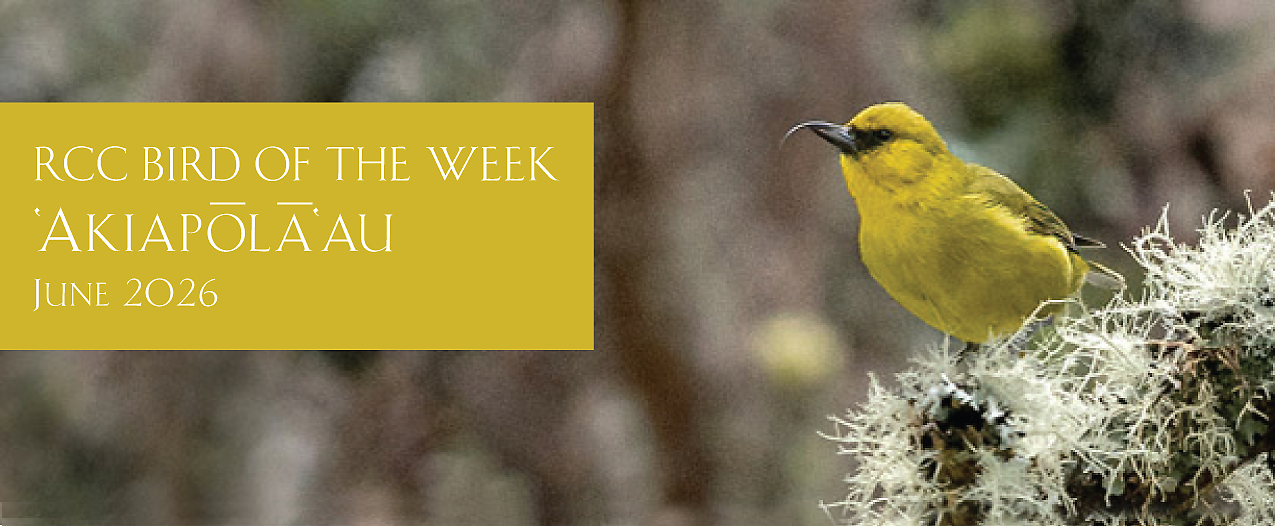
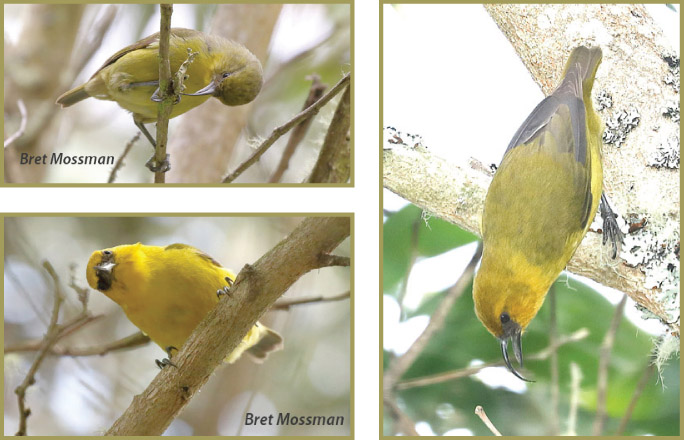
ʻAkiapōlāʻau - Ross Feldner Aloha! This week we’re off to visit the largest island in the United States, Hawaii, also known as “the big island.” Living here and nowhere else is the ʻAkiapōlāʻau, a species of honeycreeper that is endangered due to many threats, including introduced rats, pigs, cats, dogs, mosquitos, and, of course, habitat loss. It was included on the endangered species list back in 1967 because of its fragmented population, low numbers and low reproduction rate. ʻAkiapōlāʻau only breed every other year! ʻAkiapōlāʻau feed on insects which they find hidden within the branches of trees, along with the nectar of flowers shaped like its bill. It also looks for invertebrates at the floor of the forest where there is a large amount of natural growth. This bird uses its long bill to peck open bark to reach larvae; it then uses its thin upper bill to probe out its meal and its lower bill to crush it. ʻAkiapōlāʻau live in three distinct populations between 4,875–6,500 feet elevation on the Island of Hawaii. Their original range likely included all forested areas of the island. They nest in open cups usually in the ‘Ōhi‘a lehua, a slow growing tree endemic to the six largest islands of Hawaii and the most common native Hawaiian tree, comprising 80% of Hawaii’s native forests. | |