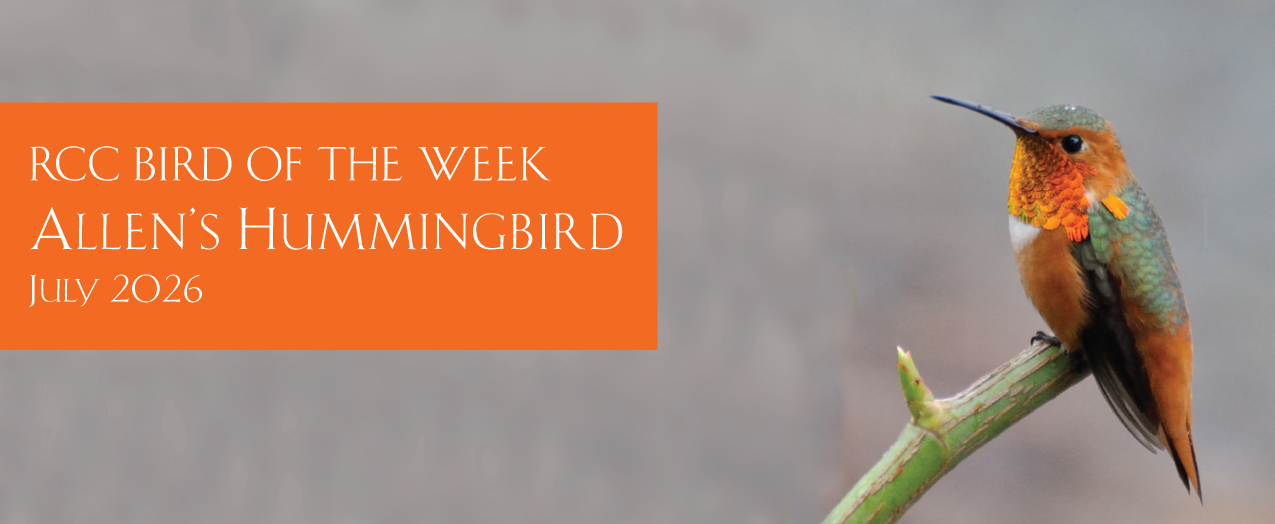
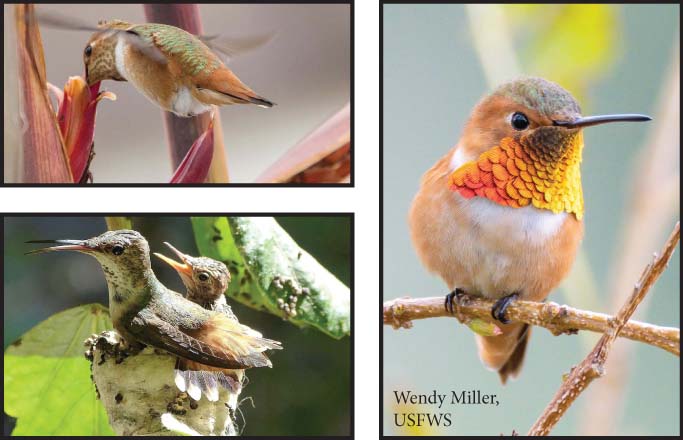
Allen's Hummingbird - Ross Feldner Known for its vibrant flashy colors, Allen's Hummingbird is about 3 to 3.5 in length, weighs approximately 2 to 4 grams and is commonly found near brushy woods, gardens and meadows in coastal California. Like all hummingbirds, Allen's Hummingbird's high rate of metabolism requires it to feed frequently. It drinks nectar from flowers and eats small insects (such as flies, ants, small beetles, spiders, and tiny wasps) in flight or from flower blossoms, providing needed protein and energy. They need to feed every 10 to 15 minutes, visiting up to 1,000 flowers a day and consuming over twice their own body weight in nectar daily! On hot days, since they lack sweat glands, they shed excess body heat by dangling their feet in the air during flight exposing their skin to cool down. The courtship flight of male Allen's Hummingbirds is a frantic back-and-forth flight arc of about 25 feet. It is similar to the motion of a swinging pendulum, followed by a high-speed dive from about 100 feet during which tail feathers emit a characteristic sharp flutter to further attract attention of the female. Male Allen's Hummingbirds, like most hummingbirds, are aggressive and territorial, chasing other males and different hummingbird species from their territory. They have even been known to attack and drive off predatory birds much larger than themselves, including kestrels and hawks! Allen's Hummingbird constructs its nest out of plant fibers, down, and weed stems, coating the nest with lichens and spider webs to give it structure. This process is gradual, taking about a week to build a nest of adequate size. They put their nests in spots that are safe to keep them away from predators. | |