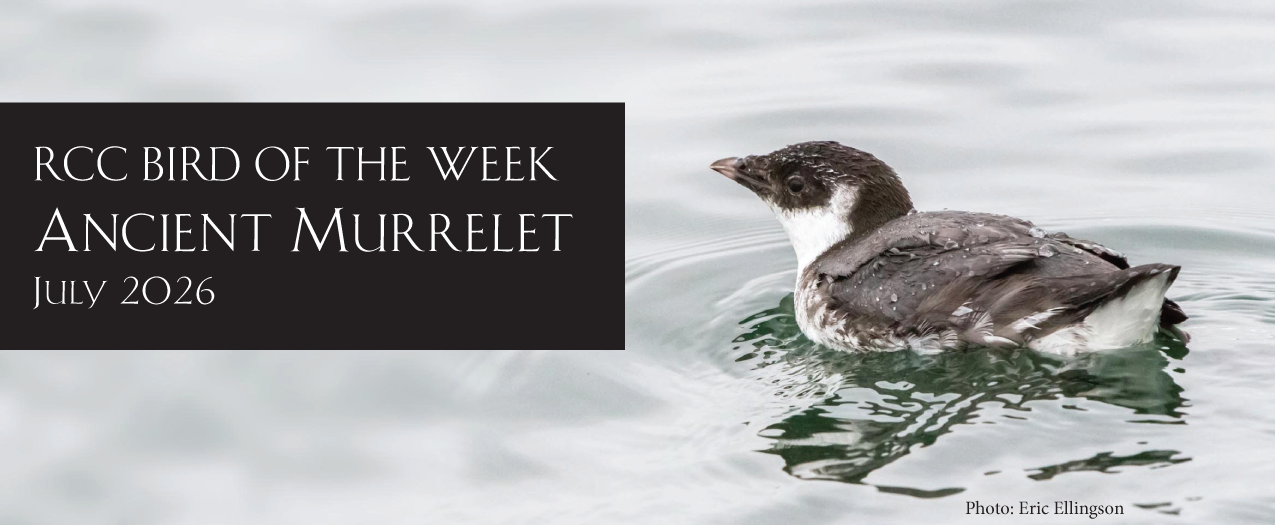
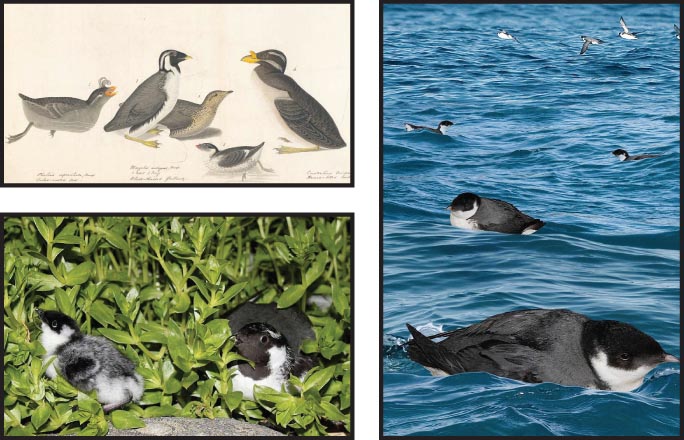
Ancient Murrelet - Ross Feldner No, it’s not the Ancient Mariner. But this member of the auk family is called "ancient" because it has grey on its back like a hoary shawl. The Ancient Murrelet can be found in Alaska where it breeds in the Aleutian Islands as well as along the California coast where it winters. Like other auks, Ancient Murrelets forage by swimming underwater using their wings for propulsion. Although their diet is poorly known, it’s thought that during winter it consists mainly of crustacea, while in summer both small fish and crustaceans are eaten. They exhibit an unusual breeding behavior for a seabird. Males "sing" at night from tree branches and other high perches at nesting colonies. They nest in burrows excavated in forest soil among tree roots, under logs or in grass tussocks, occasionally in rock crevices. They arrive at and depart from their nesting grounds at night, presumably to reduce predation, and perhaps for the same reason the young are never fed at the nest, but are taken to sea 1–3 days after hatching! Although listed as a species of "Least Concern" in the U.S., the Ancient Murrelet is listed as "Special Concern" in Canada because populations have been greatly reduced over the past century by predators such as rats introduced to their breeding islands by visiting ships in the 1800s. | |