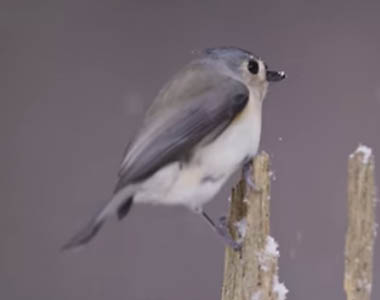
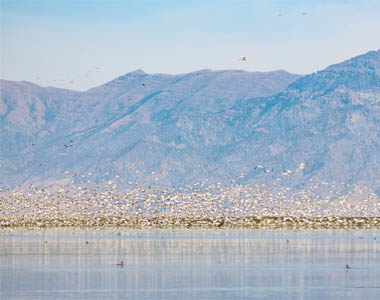
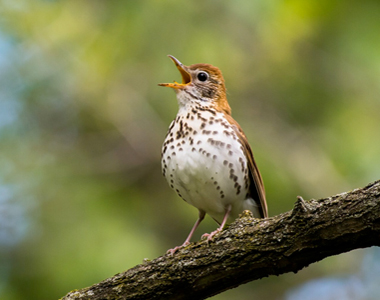
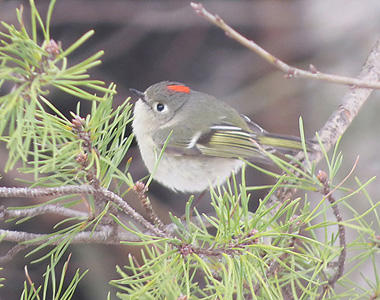
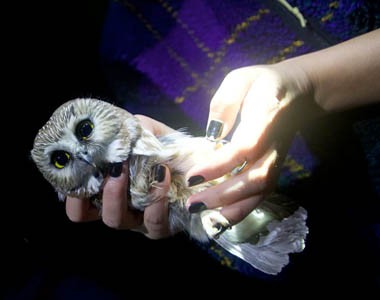
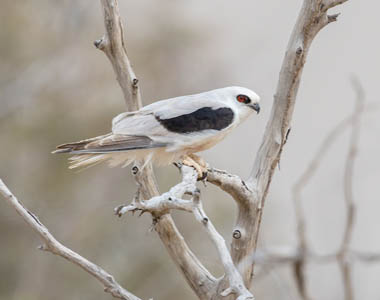
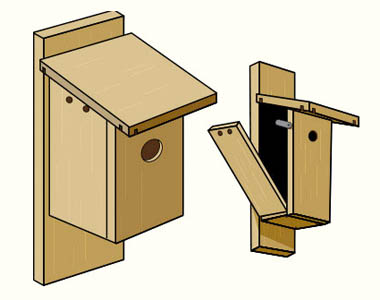
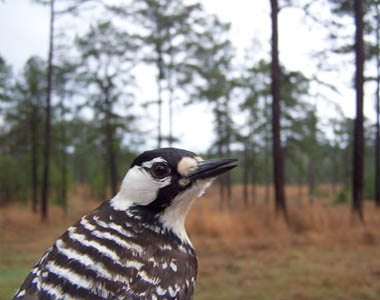
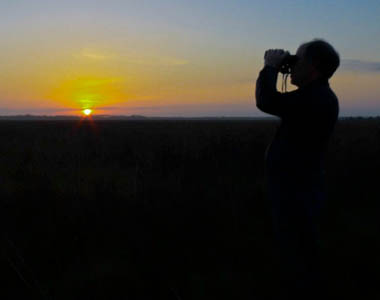
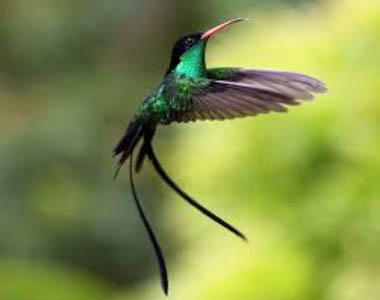
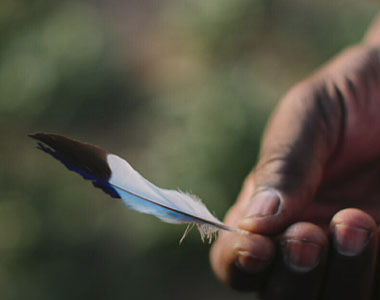
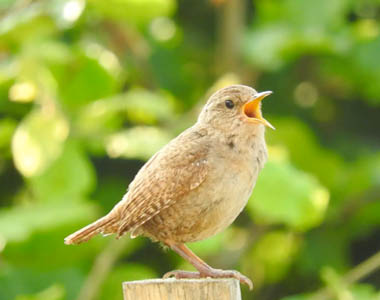
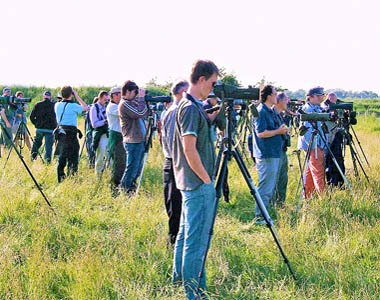
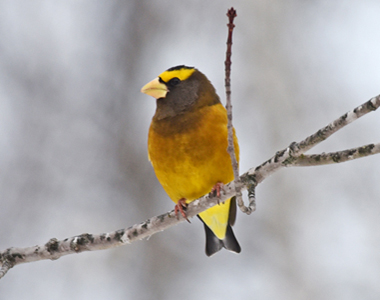
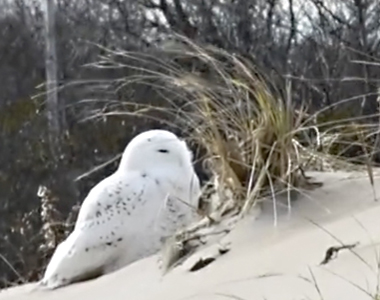
| | This winter is a good time to watch birds through your window with your favorite warming drink in hand. Or, you can go for short, quick neighborhood walks that get you back inside before frostbite sets in. Just before a nationwide arctic blast hit most of the U.S. with frigid temperatures and huge amounts of snow, ice, and sleety rain, I had a transcendent moment no more than 50 yards from my home. 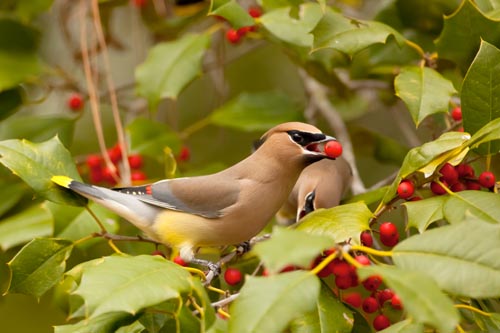 Bundled up like Charlie Brown, I had just stepped outside when a flock of small birds flew over me and landed in the big, bare red maple tree across the street, looking much like small yellow ornaments left over from Christmas. My omnipresent binoculars revealed a posse of Cedar Waxwings, a bird that I had never seen before from my own front yard! Then with precision worthy of military jets, they swooped directly over my head, landing in the holly tree immediately in front of me. For the next 15 minutes, even after the cold had us retreat indoors, my wife and I (whom I had called madly to join me) stared in awe as “our” Cedar Waxwings moved back and forth devouring the red berries that adorn our holly. Bundled up like Charlie Brown, I had just stepped outside when a flock of small birds flew over me and landed in the big, bare red maple tree across the street, looking much like small yellow ornaments left over from Christmas. My omnipresent binoculars revealed a posse of Cedar Waxwings, a bird that I had never seen before from my own front yard! Then with precision worthy of military jets, they swooped directly over my head, landing in the holly tree immediately in front of me. For the next 15 minutes, even after the cold had us retreat indoors, my wife and I (whom I had called madly to join me) stared in awe as “our” Cedar Waxwings moved back and forth devouring the red berries that adorn our holly. How do these small, gorgeous, tawny, burnished gold birds -- with red tips on their wings, a brilliant daub of bright yellow on their tail, a bold robber’s mask, and a crazy crest on their head manage to survive outside in winter? They are wanderers, constantly searching for berries and so are not seen regularly like the chickadees foraging your feeders. That’s why this January, 2026 issue of RCC’s Bird Watch and Wonder starts off in “Climate and Ecology” with Tina and Russell Laman’s story that unlocks some of the mystery of birds that you can see in your own yard this winter: “How Birds Stay Warm in the Winter Snow.” As you marvel, letting out frequent “oohs” and “ahs,” between gulps of sherry, at the chickadees, titmice, small woodpeckers, and nuthatches that seem to gambol and play in your cold, snowy yard, you may also wonder why tiny birds like this are seen as cute. And, are there are others you should know about? Our birdmeister, Ross Feldner, has, of course, come to your rescue in our “Bird Findings” section with a collection of the smallest, cutest birds there are. 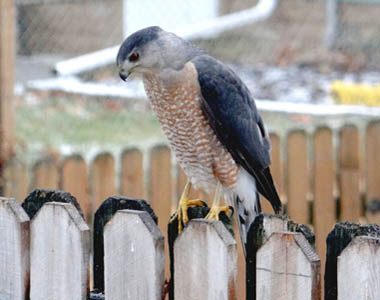 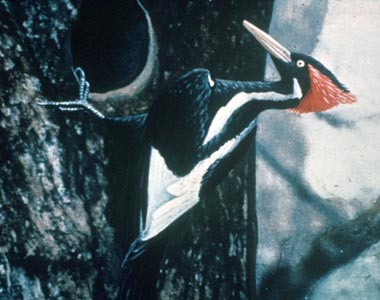 During your at home birding this winter, you may, however, catch sight of some not so cute, large birds like Cooper’s Hawks that like to carry out swift, sneak attacks around your bird feeders in order to turn your little birds into tasty tidbits. But, the largest, most spectacular and bird you will never see is the Ivory-billed Woodpecker (or Lord God Bird). RCC National Advisory Council member J. Drew Lanham follows this now extinct (or is it?) gigantic woodpecker, a Southern swamp forest dweller, in his mind, spirit, hopes and dreams. The result is a masterpiece of writing that takes us through the history, culture, and dark days of our nation’s past and examines why we must not simply see birds (or others) as objects to be observed, counted, killed and mounted. During your at home birding this winter, you may, however, catch sight of some not so cute, large birds like Cooper’s Hawks that like to carry out swift, sneak attacks around your bird feeders in order to turn your little birds into tasty tidbits. But, the largest, most spectacular and bird you will never see is the Ivory-billed Woodpecker (or Lord God Bird). RCC National Advisory Council member J. Drew Lanham follows this now extinct (or is it?) gigantic woodpecker, a Southern swamp forest dweller, in his mind, spirit, hopes and dreams. The result is a masterpiece of writing that takes us through the history, culture, and dark days of our nation’s past and examines why we must not simply see birds (or others) as objects to be observed, counted, killed and mounted. There is much more in our January issue – films, festivals, “The Best of Momentary Meditations,” “The Best of Bird of the Week” and more for you to savor without going out into the cold. And, as winter’s night settles in, check our “Books” section to find a volume that may stir your imagination and your soul as did Drew Lanham’s Lord God Bird. Prop your feet up by the fireplace, and warm up to and dream about the wonders of bird life in Paul Bannick’s Woodpecker: A Year in the Life of North American Woodpeckers. | | | | | | 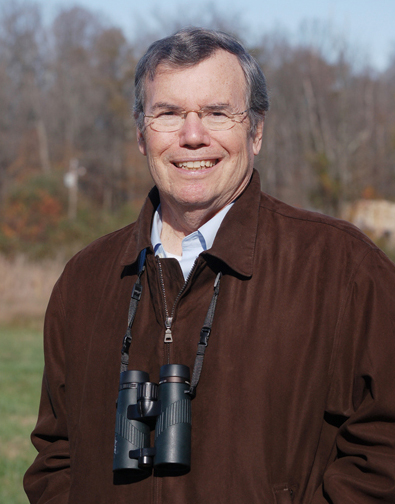 Bob Musil, an avid birder, is the President & CEO of the Rachel Carson Council and author of Rachel Carson and Her Sisters: Extraordinary Women Who Have Shaped America’s Environment (Rutgers, 2016) and Washington in Spring: A Nature Journal for a Changing Capital (Bartleby, 2016). Bob Musil, an avid birder, is the President & CEO of the Rachel Carson Council and author of Rachel Carson and Her Sisters: Extraordinary Women Who Have Shaped America’s Environment (Rutgers, 2016) and Washington in Spring: A Nature Journal for a Changing Capital (Bartleby, 2016). | | | | | | How Birds Stay Warm in the Winter Snow: Backyard Birds Revealed Birds look extra beautiful against a backdrop of snowflakes—and they’re often more active, too, as they search for food, water, and shelter to stay warm. Using slow-motion and super-wide-angle cameras, Tim and Russell Laman get close to some local favorites like turkeys, Blue Jays, Carolina Wrens, nuthatches, and chickadees. Their cameras capture the beauty of falling snowflakes as well as the resourcefulness of hardy birds. | | | | | | | | New Policy Tools and Funding Bring Much-Needed Support to Great Salt Lake In a nearly record-low water year, new water distribution plan, policy changes, and funding commitments to benefit the lake. Below-average runoff and persistent drought are driving water levels close to record lows once again at Great Salt Lake. These conditions serve as a stark reminder that preserving the lake and its wetlands is a continuous endeavor—one that will take collective action and partnership every year. | | | | | | | | New Study Reveals Central America’s “Five Great Forests” Are Lifelines for North America’s Migratory Birds Every spring, the familiar songs of Wood Thrushes and warblers return to the parks and backyards of eastern North America. But their journey begins far to the south—in the lush, remote forests of Central America that sustain them throughout most of the year. A new study from the Wildlife Conservation Society (WCS) and the Cornell Lab of Ornithology (Cornell Lab), reveals that the Five Great Forests of Central America—are indispensable lifelines for dozens of migratory bird species that link the Americas. | | | | | | | | Good Things Come in Small Packages The adjective cute describes something that’s attractive in a pleasing, nonthreatening way. Things that are small or young are often described as cute. We all love tiny things: miniatures, models, babies and, of course, small adorable birds. Having previously written about the biggest birds, I figured let’s go the other way and find out about some of the smallest (and cutest) birds in America. I present to you the ten smallest birds in America. | | | | | | | | The Tiniest Owl You’ve Never Seen A close encounter with a northern saw-whet. Say what you will about the fall time change, but it does make catching night owls a little easier. At sunset, after her day job, Julie Woodruff heads up into the hills of Pepperwood Preserve, in the Mayacamas just north of Santa Rosa, to meet a small crew of volunteers—four or five days a week, all fall long. They string up 60 feet of nearly invisible mist nets, crank up a speaker playing what sounds like a truck backing up, and wait to see what flies in. | | | | | | | | Amy Tan Shares Her Best Birding Tips Amy Tan has always loved nature. From the age of eight, the novelist was plucking snakes and lizards from a creek near her suburban home in Northern California. But birds entered the picture much later. In 2016, at 64, Tan began taking classes on how to draw and journal about birds. In the backyard of her Bay Area home, her subjects included hummingbirds, jays, sparrows, finches, warblers, and owls. Her lovely drawings and witty journal entries were published last year in her best-selling book, The Backyard Bird Chronicles. | | | | | | | | Discover a New World of Birding... Your sightings contribute to hundreds of conservation decisions and peer-reviewed papers, thousands of student projects, and help inform bird research worldwide. Explore birds and hotspots near you and wherever you go, all based on the latest sightings from around the world. Join the world's largest birding community. Every sighting matters. Contribute yours. | | | | | | | | A Hawk Has Started Hunting the Feeder Birds in My Yard. What Can I Do? Hawks that feed on birds apparently take the term bird feeder at face value. If you want to discourage the hawk, you’ll have to take your feeders down for a few days, until the smaller birds disperse. In the wild, birds face constantly fluctuating food supplies, so songbirds, doves, and hawks alike will know to search for food elsewhere. | | | | | | | | All About Birdhouses For many species of birds, there is a shortage of great places to nest. There may be birds that would love to call your habitat home, but they have a specific nesting requirement which needs to be met. Birdhouses can be placed in backyards, schoolyards, parks, orchards, farms, pastures, cemeteries, woodlots, deserts, cities…you name it. Support more nesting birds, and give a bird a home. Use these resources to become the ultimate nest box landlord. | | | | | | | | Elusive Orchid Plays Key Role in Plan to Bring Bird Back After 30 Years Once widespread throughout the Southeast, populations of the red-cockaded woodpecker shrank drastically amid rapid development and other threats. The last time anyone spotted a red-cockaded woodpecker in Tennessee, Bill Clinton was in his first term in the White House. Tom Hanks was starring as Forrest Gump on the silver screen, and a new television show named “Friends” was a month from hitting the airwaves. | | | | | | | | | | Birdwatching's Carbon Problem How might any of us continue to enjoy and protect nature on a damaged planet? ALTHOUGH it has achieved a kind of celebrity status among birdwatchers, let’s be honest about the Five-striped Sparrow: it’s no bird-of-paradise. Brown and sooty, the sparrow is named for five white stripes that fan out across its face and throat — an arrangement not particularly unusual among sparrows. | | | | | | | | Lord God Bird Does the Ivory-billed Woodpecker Still Exist? IMAGINE, IF YOU WILL, a bird with an obsidian black body, ebony dark as a night sky; an almost iridescent star-burnt plumage emboldened by a bolt of white lightning running from mouth to tail, and a similar bolt charging the wings’ trailing edges. It is a rather large bird, not ostrich gargantuan or even wild turkey–size, but bigger than any such forest-lurking, flying bird you’ve ever seen. It hangs on the side of an enormous tree, perhaps an ancient hackberry or a bald cypress. | | | | | | | | The Smithsonian’s $69 Million Dollar Mistake The Smithsonian’s new Bird House is an impressive scientific space, designed to educate visitors about bird migration, conservation, and the ecological roles of birds across the Americas. For first-time visitors, it is clear that immense care went into creating immersive habitats, sustainability upgrades, and bilingual educational signage. But for those who remember the old Bird House that closed in 2017, the experience is unmistakably different. | | | | | | | | In the Quiet After Storms: Still Humming Just before Jamaica wakes, while hills hold their breath and the world hovers between night and morning, the Doctor Bird is already in motion. The Red-billed Streamertail (Trochilus polytmus) is endemic to the island, found nowhere else on earth. The males, with their long tail streamers trailing like silk ribbons, often dominate our national imagination, personifying the phrase “likke but tallawah”. But every bird, male and female alike, plays a quieter role in keeping this place alive. | | | | | | | | Feathered Folklore: Birds and Their Amazing Avatars From heroic acts to saviors of mankind, birds are important characters in legend and folklore. Birds are capable of amazing feats. Arctic terns migrate from one pole to the other and back in a single year. But that’s nothing compared to what birds have achieved in folklore. Legends of their heroics explain how ancient people interpreted bird behavior and how that has played a pivotal role in our perception of them. | | | | | | | | Myths and Folklore of Bird Feathers: Mystical Plumes Across Cultures Bird feathers have historically held a profound place in myths, folklore, and cultural traditions. Revered for their connection to the heavens and their association with the spiritual realm, feathers have been symbols of power, wisdom, and transformation across cultures. In many cultures, bird feathers are seen as gifts from the divine. Their presence is often interpreted as a message from the spiritual realm. | | | | | | | | Portraits of Birds: Meet Jon Janosik Today’s Birds of a Feather looks at the fascinating and enlightening life so far of one of America’s finest bird artists, Jon Janosik. Say those initial letters with a ‘yuh’ sound; this Oregon resident has a lineage hailing back to Upper Lusatia, an area that we now know as parts of the Czech Republic, Poland, and Germany. Like his namesake 18th century ancestor, today’s interviewee has a moral core made of respect and passion for the world, reflected in his love for the science and art of birds. | | | | | | | | Classical Music (is) for the Birds Q: What do you call birds who don’t know the song lyrics? A: Hummingbirds. Cheeky blog title aside, there are many examples of classical composers who have been inspired by birds, bird legends, and of course, bird songs. While clucking chickens and elegant swans and others in the avian world aren’t necessarily limited to springtime appearances, I thought it would be fun to put the birds front and center now that it’s the season we start to spend more time outdoors. | | | | | | | | Birding Festivals and Events A great way to enjoy birdwatching is by going to festivals—they’re organized to get you to well-known birding spots at the right time of year, and they’re a perfect way to meet people. Experts and locals help you see more birds, and you’ll meet other visitors who share your hobby. While you’re there, keep an eye out for Cornell Lab representatives, as we do attend several festivals each year. | | | | | | | | Evening Grosbeak This large member of the finch family is another case of odd naming. Early English settlers, because of their erroneous belief that it came out the woods to sing only after sundown, called it the “Evening” Grosbeak. Early French settlers were more accurate calling it le gros-bec errant, meaning the wandering big-bill, or grosbeak. They forage in trees and bushes in search of seeds, berries, and insects. Their large, powerful bills enable them to crush seeds that are too tough for other seed eaters. | | | | | | | | Momentary Meditations are published every Monday to awaken what Rachel Carson called “the sense of wonder” and what Albert Schweitzer called “a reverence for life.” Looking deeply into our interdependence with all life on earth helps us know what we must do. In our harried world, these meditations are meant to serve as a renewable resource for compassion and love. Relentless Wind - While I braced myself against the cold and relentless wind on Plum Island, MA, this young, immature female Snowy Owl remained almost motionless. Her confidence invited me to resist my thoughts of returning quickly to my car. | | | | | | | | H is for Hawk 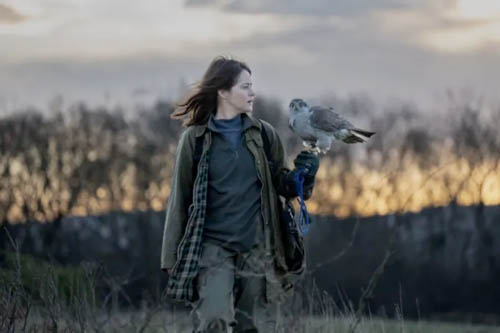 Claire Foy Is Enraptured With Raptors in an Unconventional Yet Moving Grief Drama. Claire Foy Is Enraptured With Raptors in an Unconventional Yet Moving Grief Drama.
Philippa Lowthorpe pares Helen Macdonald’s intricately layered memoir down to what she considers essential, focusing on the author’s odd choice to adopt a goshawk as a kind of emotional escapism.
As a movie, “H Is for Hawk” — which stars Claire Foy as a headstrong and occasionally hard-to-take version of Macdonald — might have a similarly comforting effect for some, although it elides so much of what originally resonated with me (namely, the language, for which Macdonald has a remarkable gift). What is gained in exchange is a visual dimension entirely lacking from the book, as director Philippa Lowthorpe supplies footage of Foy enraptured with her raptor, whom she names Mabel — so much footage in fact that the 130-minute film stops being a work of philosophy and reflection and becomes instead a more conventional portrait of a human with an exceptional pet. (That’s a word that ruffles Helen’s feathers, as she considers Mabel to be more of a companion.) READ MORE | | | | | | Woodpecker: A Year in the Life of North American Woodpeckers 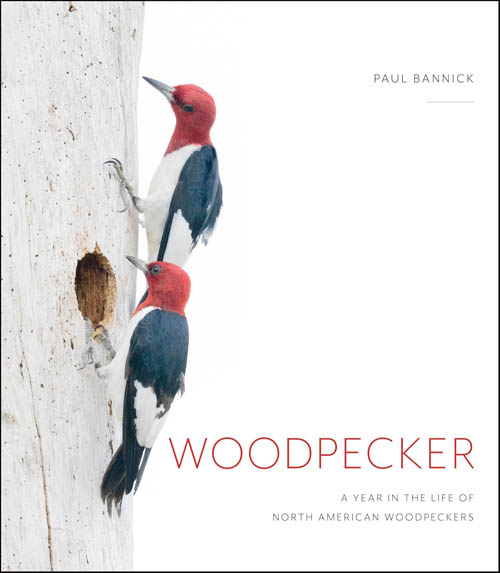 "Wholly absorbing--a sure-fire way to turn even a casual birder into a woodpecker fanatic." – Kirkus Reviews "Wholly absorbing--a sure-fire way to turn even a casual birder into a woodpecker fanatic." – Kirkus Reviews
Woodpeckers are one of the most remarkable bird species found in the avian world. They have evolved in ways that make them ecologically critical to forest health, serving as keystone species in a variety of wooded habitats across North America. Their activities support a variety of other creatures, making them catalysts of diversity in the places they inhabit. They are, in many ways, the heartbeat of the forest.
Informed by his own experiences in the field as well as extensive research, author and photographer Paul Bannick delves into the natural and cultural history of woodpeckers from the boreal forest of northern Canada to oak woodlands and conifer forests in the United States to the wet tropical forests of Mexico and the Caribbean. He captures the woodpeckers’ charismatic behavior as well as their colorful displays and sensitive habitats in astonishing images. PURCHASE HERE | | | | | | | | | | The Owl Handbook: Investigating the Lives, Habits,
and Importance of These Enigmatic Birds By John Shewey 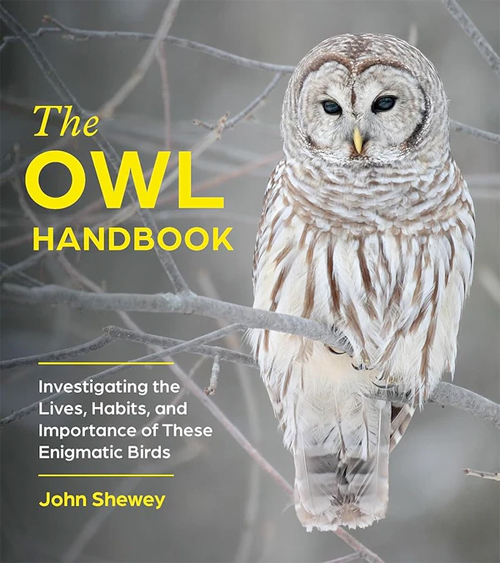 Charismatic, intriguing, and misunderstood: The Owl Handbook provides a beautifully photographed, thoughtfully researched, and accessible guide to these complex, captivating creatures. Charismatic, intriguing, and misunderstood: The Owl Handbook provides a beautifully photographed, thoughtfully researched, and accessible guide to these complex, captivating creatures.
Spot an owl that’s long been watching your every move and darker aspects of its reputation may spring to mind: harbinger of doom, guides through the spirit world, merciless bird of prey. Mythology and superstitions have projected our fear of the unknown onto these mostly night-dwelling creatures. But these wondrous birds are so much more than shadows or silent glides through the night. In The Owl Handbook, lifelong birding enthusiast John Shewey leads us through an exploration of owls’ cultural impact as seen in folklore and mythology, provides in-depth investigations of 19 owls of North America and a survey of 200 owls across the globe, and gives advice on how to respectfully observe and protect these enigmatic birds, brought to life by hundreds of full-color photographs. PURCHASE HERE | | | | | | The January 2026 issue of Bird Watch and Wonder was produced by Ross Feldner | | | |  The Rachel Carson Council Depends on Tax-deductible Gifts From Concerned Individuals Like You. Please Help If You can. The Rachel Carson Council Depends on Tax-deductible Gifts From Concerned Individuals Like You. Please Help If You can. | | | |  Sign Up Here to Receive the RCC E-News and Other RCC Newsletters, Information and Alerts. Sign Up Here to Receive the RCC E-News and Other RCC Newsletters, Information and Alerts. | | | | | | RACHEL CARSON COUNCIL
8600 Irvington Avenue
Bethesda, MD 20817
(571) 262-9148
[email protected] | | | | | | | | | | | |