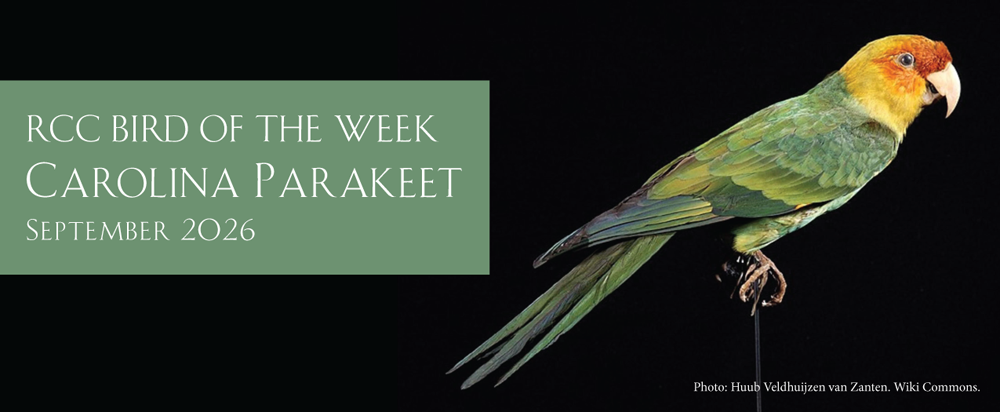
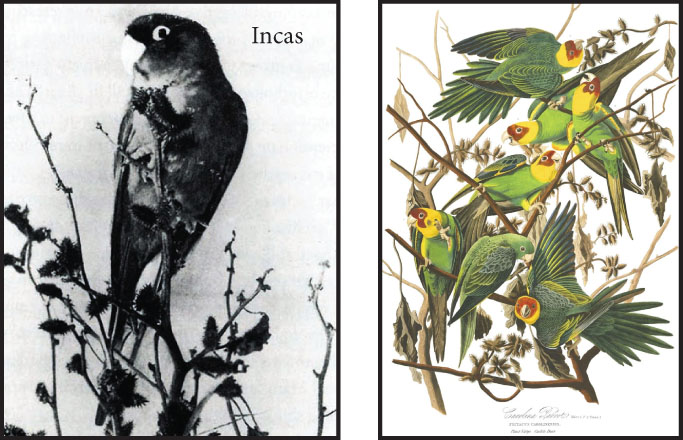
Carolina Parakeet - Ross Feldner “We have met the enemy and he is us.” – Cartoonist Walt Kelly from the cartoon Pogo. Evidence shows that humans had at large role in the extinction of the Carolina Parakeet. Foremost was deforestation in the 18th and 19th centuries. They were hunted for decorative use of their colorful feathers used as adornment on women's hats, and killed to reduce their crop predation. Their flocking behavior also contributed to their downfall, as they would return to the vicinity of dead and dying birds enabling wholesale slaughter. The last confirmed sighting of this colorful, gregarious bird was in 1910. Ironically the last known specimen, a male named Incas, perished in captivity at the Cincinnati Zoo in 1918, the same zoo, in the same cage, where the last Passenger Pigeon, Martha, died. The Carolina Parakeet was declared extinct in 1939. It had the northernmost range of any known parrot. It was found from southern New York and Wisconsin to Kentucky, Tennessee, and the Gulf of Mexico, from the Atlantic Seaboard to as far west as eastern Colorado. It lived in old-growth forests along rivers and in swamps. It lived in huge, noisy flocks of as many as 300 birds building nests in hollow trees. Multiple female parakeets would often deposit their eggs into one nest. Carolina Parakeets mostly ate the seeds of forest trees and shrubs, including those of cypress, hackberry, beech, sycamore, elm, pine, maple, oak, and other plants such as thistles and sandspurs as well as fruits, including apples, grapes, and figs and occasionally insects. |