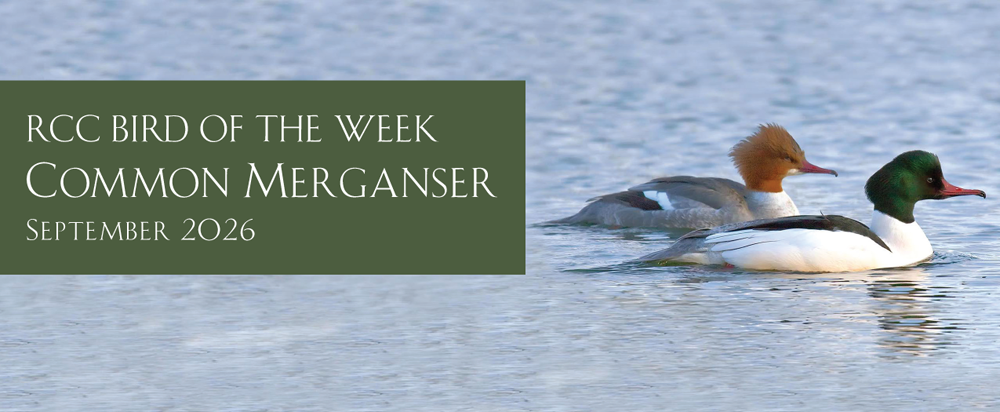
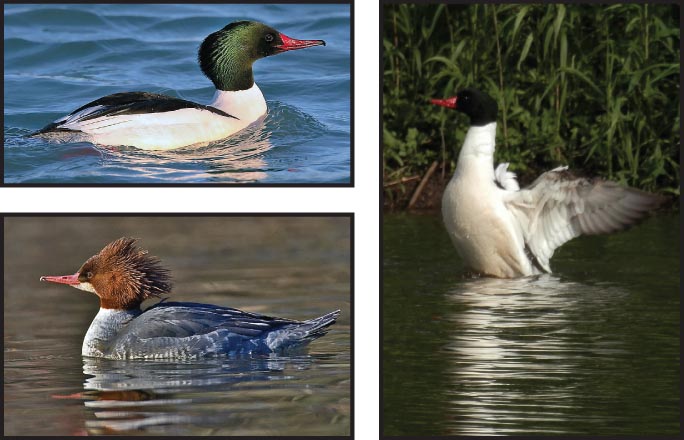
Common Merganser - Ross Feldner The Common Merganser is equally at home in salt and fresh water. In larger streams and rivers, they act like river rafters and float down with the current for a few miles and either fly back or, more commonly, fish their way back, diving all the way. They often fish in a group forming a semicircle, driving the fish into shallow water where they are easy to catch. They form smaller groups or pairs in smaller streams as they float down stream, twirling round and round in the rapids, often fishing in a deep pool at the foot of a waterfall or rapid. They can act like dabbling ducks, but they can also swim deep in the water like cormorants. Common Mergansers often sit on a rock in the middle of the water, similar to cormorants, with their wings half-open to the sun. To lift off from the water, they flap along the surface for many yards. Once they are airborne, their flight is strong and fast. As with other mergansers, these piscivorous (primarily eats fish) ducks have serrated edges to their bills to help them grip their prey. In addition to fish, they take a wide range of other aquatic prey, such as molluscs, crustaceans, worms, insect larvae, and amphibians; more rarely, small mammals and birds. Nesting is usually in a tree cavity, so the Common Merganser requires mature forest as its breeding habitat. Immediately after hatching the young mergansers are carried by the mother on her back to rivers or lakes, where they feed on freshwater invertebrates and small fish fry | |