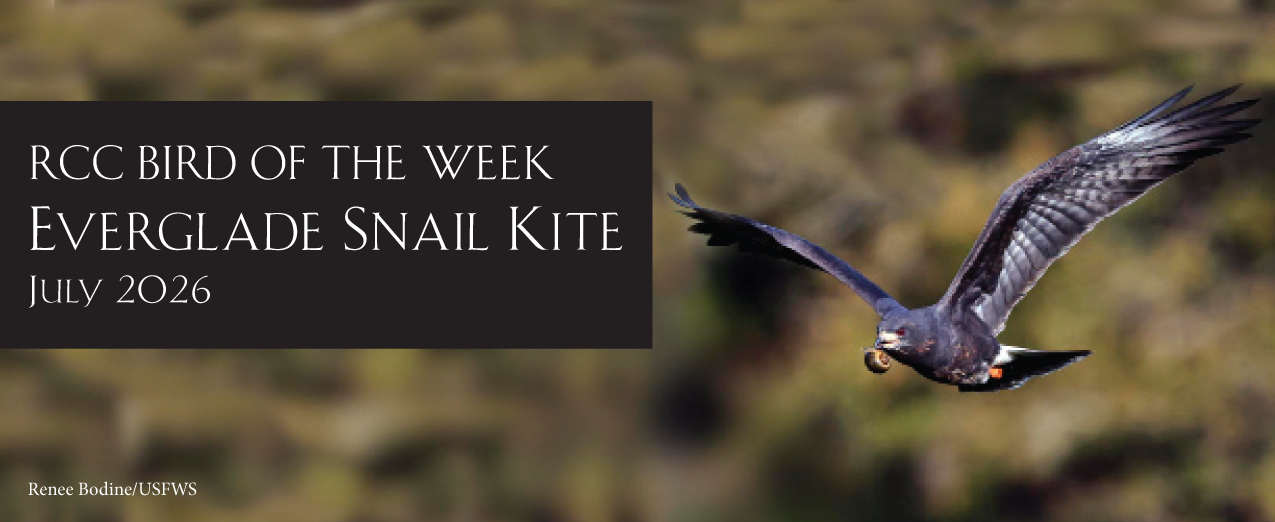
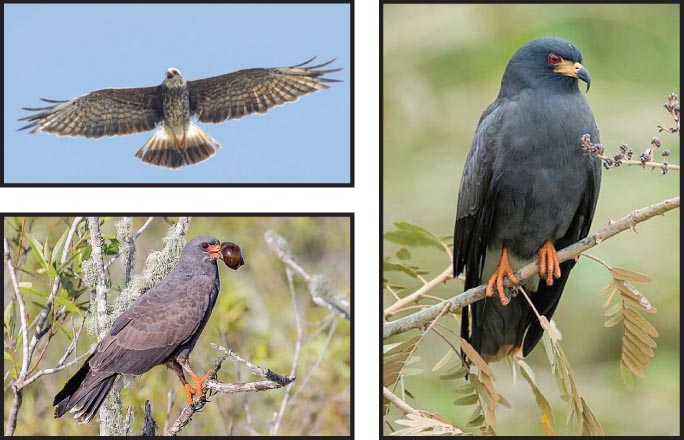
Everglade Snail Kite - Ross Feldner I’m sure you can guess what’s on this bird’s menu. The Everglade Snail Kite’s diet consists almost exclusively of apple snails, a large fresh water snail. When not dining on snails, these kites will eat crayfish, small turtles, some snakes and small rodents. The Everglade Snail Kite’s strongly curved bill fits neatly inside the snail’s shell to pull out the prey. Talk about adaptation! While reliant on apple snails, they have adapted to eating the invasive, larger “channeled” apple snail, which may be aiding their survival. They are a locally endangered species in the Florida Everglades with a population of less than 400 breeding pairs. Much of their decline in numbers is due to the drainage and habitat destruction of the Everglades which is depleting the population of apple snails. In fact, Everglades National Park preserves only about one-fifth of the original extent of the Everglades. Everglade Snail Kites nest in a bush or on the ground, usually laying 3-4 eggs. Courtship behavior consists of males bringing food and nesting material to potential mates. Their nests, a woven configuration of sticks and dry plant material, are built in a wide variety of vegetation over water to reduce access by predators. Everglade Snail Kites require foraging areas that are relatively clear and open, flying slowly with their head facing down so that they can visually search for apple snails. Dense vegetation is not conducive to efficient foraging. | |