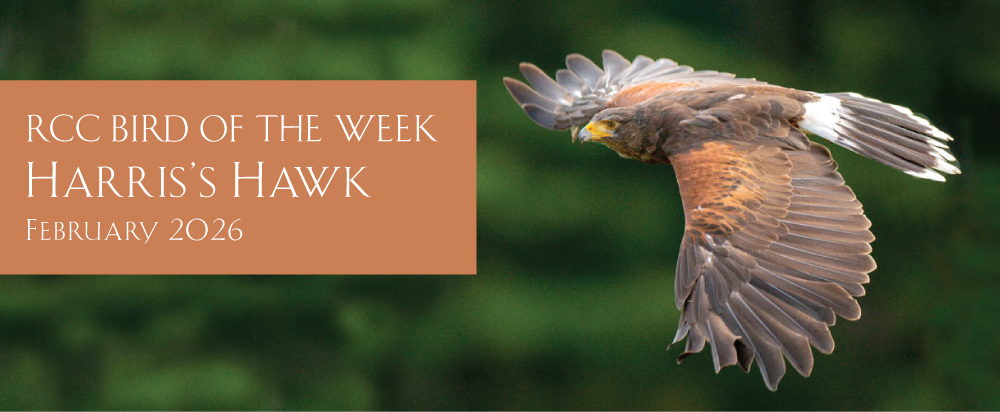
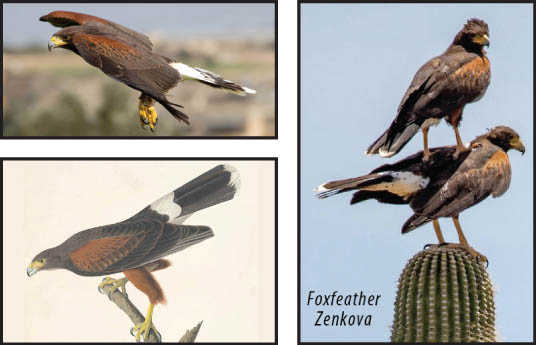
Harris's Hawk - Ross Feldner What sets this medium-large hawk apart from other hawks is its behavior of hunting cooperatively in groups like an aerial wolfpack while other raptors usually hunt alone. Harris's Hawks are considered highly intelligent, which makes them easy to train and has made them a popular bird for use in falconry. You will find this raptor in the Southwest United States in sparse woodland and semi-desert, as well as marshes in some parts of their range which may include mangrove swamps. Important perches and nest supports are provided by scattered larger trees live and dead, utility poles, boulders, and saguaro cacti. They prey on ground squirrels, rabbits, as well as snakes, lizards, large insects and quail. A pack of Harris’s Hawks can even take down an adult black-tailed jackrabbit weighing more than 4.5 pounds! Not only do they cooperate in hunting, but they also assist in the nesting process. Harris's Hawks hunt in cooperative groups of two to six. It’s thought that this is an adaptation to the lack of prey in the desert climate in which they live. In one hunting technique, a small group flies ahead and scouts, then another group member flies ahead and scouts, and this continues until prey is bagged and shared. They nest in small trees, shrubby growth, or cacti. The nests are usually compact, made of sticks, plant roots, and stems and are often lined with leaves, moss, bark, and plant roots. | |