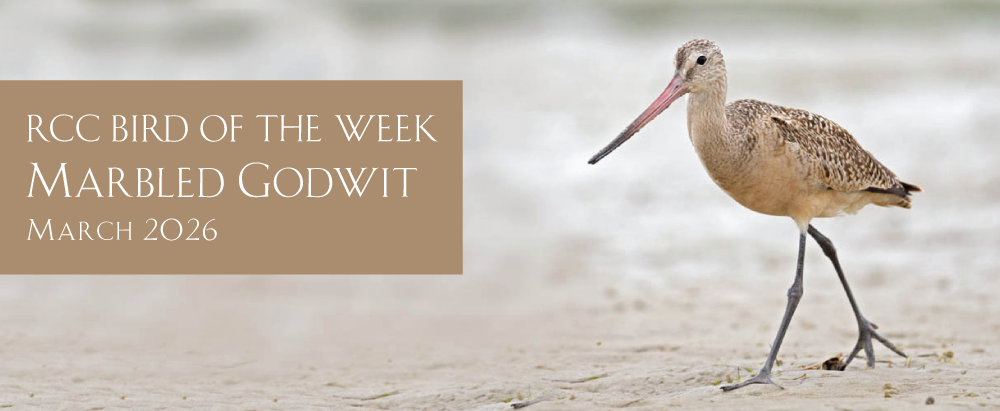
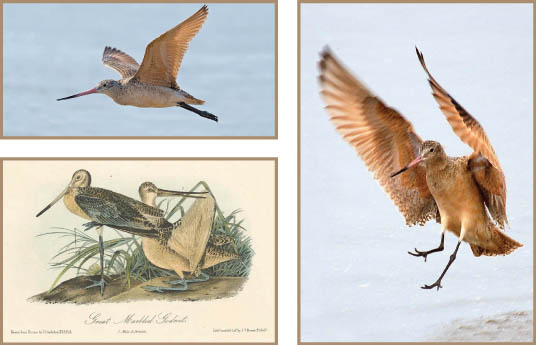
Marbled Godwit - Ross Feldner The largest of the four species of godwit, the Marbled Godwit keeps a strict schedule. When the tide is out, they eat. When the tide is in, they roost. These birds forage by probing with their long bills on mudflats, in marshes, or at the beach usually searching for crustaceans, often at night. During migration Marbled Godwits forage almost exclusively on plant tubers using their slightly upturned bill to snip tubers. Marbled Godwits breed in three distinct areas each with its own unique migration route. The majority breed in mid-continental North America, followed by eastern Canada and the Alaska Peninsula. Marbled Godwits require large expanses of short, sparse to moderately vegetated uplands for nesting. They are social birds, nesting in semi-colonial groups with no real territorial boundaries. The male selects a nest site in short prairie vegetation up to a quarter mile from water. The nest is a grass-lined depression in which the female lays four eggs. The primary threat identified for the species is the loss of habitat in breeding and staging sites due to conversion to agriculture Marbled Godwits have several distinctive, memorable calls. The sharp whit whit kerwhit ker-whit is usually heard in flight. A rapid fire ratica ratica ratica is most often heard during spring courtship. | |