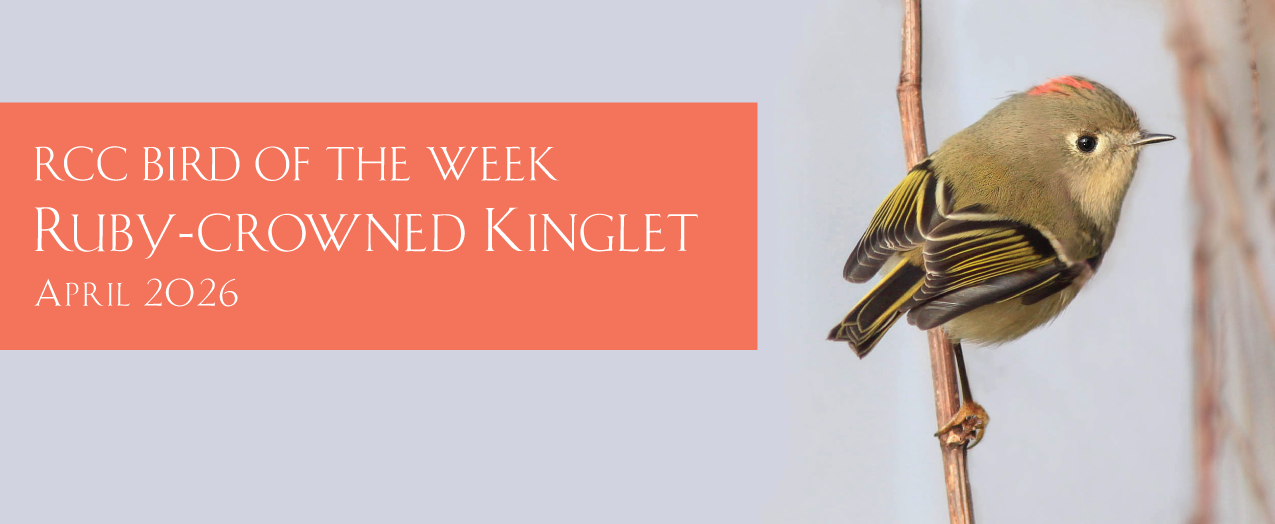
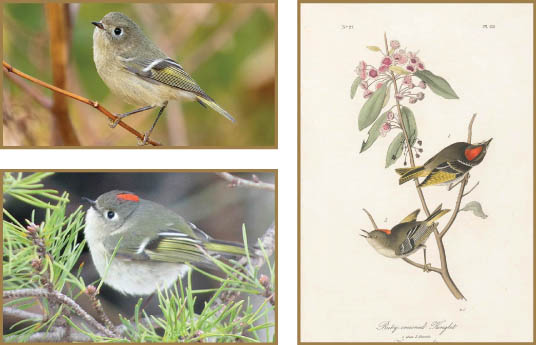
Ruby-crowned Kinglet - Ross Feldner This “fun size” bird is slightly larger than the related Golden-crowned Kinglet and can be found throughout North America. Their breeding habitat is coniferous forests across Canada, Alaska, northern New England and the western United States. They nest in a well-concealed hanging cup suspended from a tree branch and constructed with moss, twigs, feathers, conifer needles, lichens, rootlets, grasses and spider silk, lined with feathers, fine grasses, plant down and animal hair. Ruby-crowned Kinglets eat mostly insects but also eat seeds and fruits. They move along branches or through foliage with short hops, and fly with bursts of rapid wing beats. They are constantly active, and easily recognized by their characteristic wing-flicking. Their flight is described as "swift, jerky, and erratic". The Ruby-crowned Kinglet's vocalizations are remarkably loud and complex with their song divided into three main parts: a series of high pitched notes (zee-zee-zee or tee-tee-tee), two to five low trills (turr or tu), and a repeated three note "galloping" phrase (tee-da-leet, tee-da-leet). Only males sing the third part! The hard to see red crest is raised when agitated or in display. Often, they perform a "broken-wing" act to draw predators away from their nest, which they will defend fearlessly, mobbing the intruder whether it's a cat, a squirrel, or even a human! |