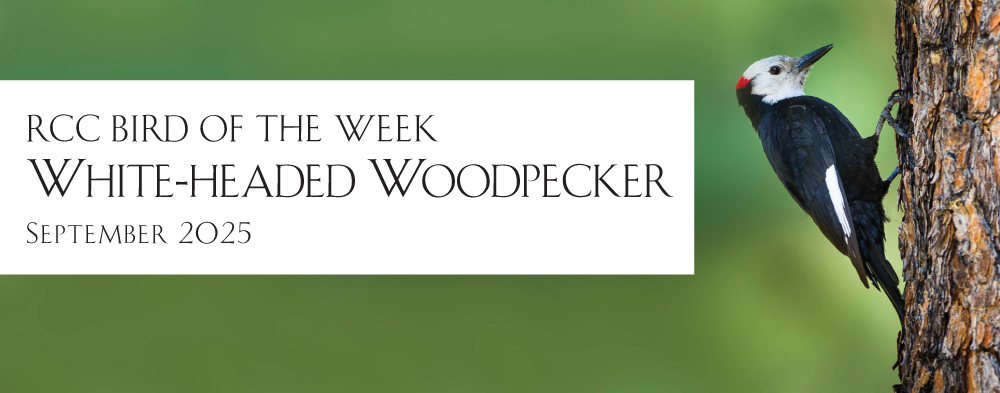
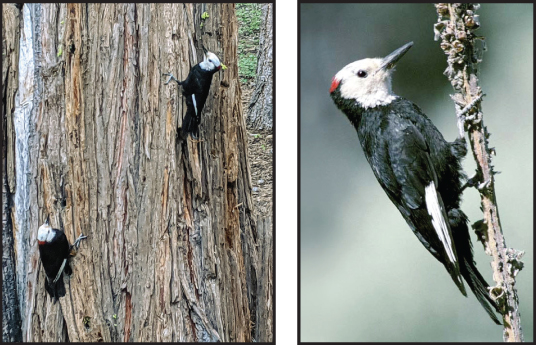
White-headed Woodpecker - Ross Feldner This medium-sized uniquely colored woodpecker lives in the pine forests of the mountains of western United States. White-headed Woodpeckers typically roost in cavities, usually in ponderosa pines, but also roost in spaces behind peeling bark and in crevices within tree trunks. Cavities are also used as winter roosts, and frequently the same cavity is used over an entire season. White-headed Woodpeckers use both live and dead trees for foraging. Pine seeds from large cones are a major part of the species diet, especially in fall and winter. They will also flake off bark to snatch insects. Unlike other woodpeckers they don’t drill holes into trees, which may explain why they have a shorter tongue than most woodpeckers. They forage methodically, often remaining on a single tree for extended periods. White-headed Woodpeckers have a unique adaptation that allows them to store pine seeds in their expandable esophagus. It is considered a rare species with a shrinking population mostly due to its dependence on mature, healthy pine forests. They are vulnerable to extended droughts, logging, forest fires, and bark beetle infestations of pine trees. White-headed Woodpeckers have a long rattling, chattering call, as well as a crisp staccato pik call, typically given two or three times. | |